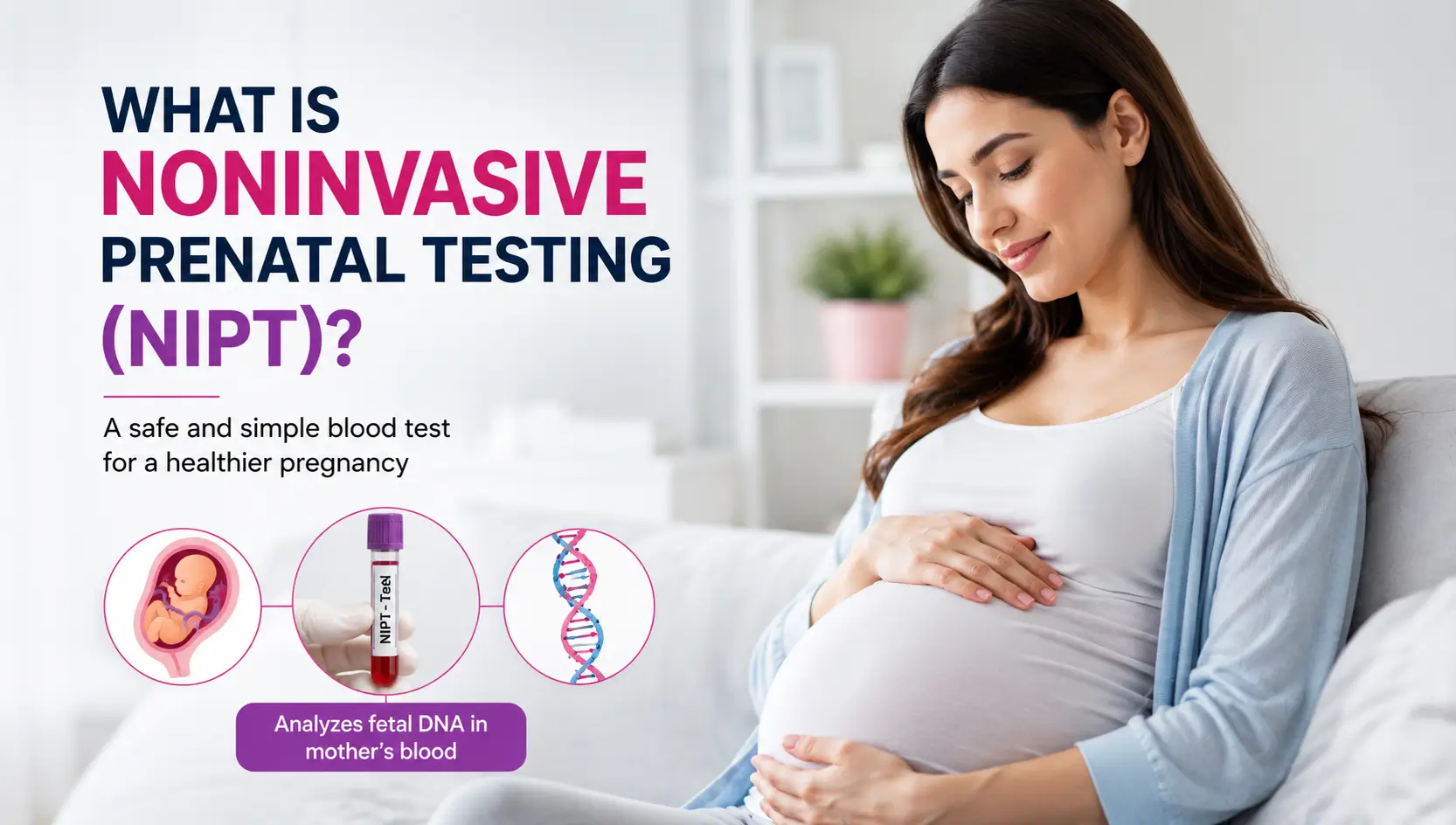
Fast Facts:
- Noninvasive prenatal testing uses a blood sample to screen for certain chromosome conditions during pregnancy.
- NIPT looks at small pieces of cell-free DNA found in the pregnant person’s blood.
- It commonly screens for Down syndrome, Edwards syndrome, and Patau syndrome.
- NIPT is a screening test, not a diagnostic test.
- A high-risk result may require additional diagnostic testing.
- The test can usually be done early in pregnancy.
- Parents should discuss results and next steps with a qualified healthcare professional.
Pregnancy can bring excitement, questions, and concerns about a baby’s development. Many parents want to understand the screening options available during early pregnancy. One option is noninvasive prenatal testing, commonly called NIPT. This simple blood test can estimate the chance of certain chromosome conditions without using an invasive procedure.
It can provide useful information early in pregnancy and help parents discuss next steps with their healthcare provider. However, it is important to understand what NIPT can and cannot tell you. This guide explains the test in clear, simple language so beginners can make better-informed decisions.
What Is Noninvasive Prenatal Testing?
Noninvasive prenatal testing is a blood-based screening test used during pregnancy.
During pregnancy, small pieces of DNA from the placenta circulate in the pregnant person’s bloodstream. These fragments are called cell-free DNA, or cfDNA.
A laboratory studies this DNA to estimate whether the pregnancy has a higher or lower chance of certain chromosome conditions.
People may also hear NIPT called noninvasive prenatal screening or NIPS.
The important point is that NIPT is a screening test. It does not provide a definite diagnosis.
How Does a Non-Invasive Prenatal Test Work?
- A non-invasive prenatal test usually begins with a simple blood draw from the pregnant person.
- The blood sample is sent to a laboratory. The laboratory examines fragments of cell-free DNA and looks for patterns linked to certain chromosome differences.
- The process does not require inserting a needle into the uterus or removing pregnancy tissue.
- Because of this, the test is described as noninvasive.
- Results are usually reported as low risk, high risk, or sometimes as an inconclusive result depending on the laboratory.
What Conditions Can Noninvasive Prenatal Tests Screen For?
Most noninvasive prenatal tests focus on common chromosome conditions.
These can include:
- Trisomy 21, also known as Down syndrome
- Trisomy 18, also known as Edwards syndrome
- Trisomy 13, also known as Patau syndrome
- Certain sex chromosome differences in some testing options
- Fetal sex information in some cases
Some laboratories may offer screening for additional genetic conditions.
However, NIPT does not check for every genetic condition or birth difference.
Parents should ask their healthcare provider what a specific test includes before choosing it.
When Can the NIPS Test for Pregnancy Be Done?
- A NIPS test for pregnancy can often be performed early in pregnancy.
- Some tests may be available from around nine or ten weeks of pregnancy.
- The exact timing depends on the laboratory, the type of pregnancy, and the healthcare provider’s recommendation.
- Testing too early may sometimes result in an insufficient amount of fetal or placental DNA in the blood sample.
- Your doctor or prenatal care provider can explain the most suitable timing.
Is Noninvasive Prenatal Screening Accurate?
- Noninvasive prenatal screening can be very effective at identifying pregnancies with an increased chance of common chromosome conditions.
- However, accuracy is not the same for every condition.
- Results may also vary depending on factors such as the pregnancy, laboratory method, and amount of cell-free DNA available.
- A low-risk result means the chance of the screened condition is lower.
- It does not completely guarantee that the baby does not have the condition.
- A high-risk result also does not confirm that the baby definitely has the condition.
What Does a High-Risk NIPT Result Mean?
- A high-risk NIPT result means the screening found a higher-than-expected chance of a particular chromosome condition.
- It is not a final diagnosis.
- Your healthcare provider may recommend genetic counseling or a diagnostic test.
- Diagnostic options may include chorionic villus sampling, commonly called CVS, or amniocentesis.
- These tests examine genetic material more directly and can provide more definite information.
Indian Egg Donors encourages intended parents and families to discuss prenatal screening results carefully with qualified medical professionals before making decisions.
What Does a Low-Risk NIPT Result Mean?
- A low-risk result means the screening did not find strong evidence of the chromosome conditions included in the test.
- For many parents, this can provide reassurance.
- However, a low-risk result does not mean the pregnancy is free from every possible genetic or developmental condition.
- Routine prenatal appointments, ultrasounds, and other recommended screenings are still important.
- NIPT should be viewed as one part of prenatal care rather than a replacement for other medical evaluations.
What Is the Noninvasive Prenatal Test Compared With Diagnostic Testing?
Many parents search for what is the non invasive prenatal test is because they want to understand how it differs from tests such as amniocentesis.
NIPT is a screening test. It estimates risk.
Diagnostic testing provides more definite answers about certain chromosome conditions.
Another difference is the procedure itself.
A non-invasive prenatal screening test only requires a blood sample. CVS and amniocentesis involve collecting pregnancy-related cells or fluid using more invasive procedures.
Your healthcare provider can help determine whether screening, diagnostic testing, or both may be appropriate.
Why Do Parents Choose Noninvasive Prenatal Testing?
Parents may choose NIPT because it can provide useful information early in pregnancy.
Common reasons include:
- The test requires only a blood sample
- It can screen for several common chromosome conditions
- Testing may be available early in pregnancy
- It can help guide conversations about additional testing
- It does not involve an invasive procedure
For families using fertility services, donor conception, or assisted reproduction, understanding prenatal screening options may also be an important part of pregnancy planning.
Indian Egg Donors supports families by providing reproductive and family-building information while encouraging patients to seek personalized medical guidance from their own healthcare team.
Should You Talk to a Doctor Before Taking NIPT?
Yes.
A healthcare provider can explain what the test screens for, its limitations, and what different results may mean.
They can also help determine whether the test is suitable for your pregnancy.
Genetic counseling may be especially useful if you receive a high-risk or unclear result.
Making decisions with professional guidance can help reduce confusion and ensure you understand all available options.
Need More Information About Pregnancy and Family-Building Support?
If you are exploring fertility, donor conception, or family-building options, Indian Egg Donors can help you learn more about available services and next steps.
- Email: info@indianeggdonors.com
- Phone: (212) 661-7177
Contact the team to discuss your questions and learn more about the support available for intended parents and families.
Frequently Asked Questions –
Q. Is NIPT safe during pregnancy?
A. Yes. NIPT requires only a blood sample from the pregnant person and does not directly enter the uterus.
Q. Can NIPT tell the baby’s gender?
A. Some NIPT options can provide information about fetal sex. Availability depends on the specific test and local rules.
Q. Does NIPT diagnose Down syndrome?
A. No. NIPT screens for an increased chance of Down syndrome. A diagnostic test may be needed for confirmation.
Q. What happens if an NIPT result is inconclusive?
A. Your healthcare provider may recommend repeating the test, waiting longer, or considering another screening or diagnostic option.
Q. Is NIPT necessary for every pregnancy?
A. Not always. Whether NIPT is appropriate depends on individual circumstances, medical history, pregnancy factors, and your healthcare provider’s advice.

Rashmi Gulati
Rashmi Gulati, MD, provides innovative, individualized health care that nurtures mind, body, and spirit. Since 2004 she has been the medical director at Patients Medical, where she delivers comprehensive personalized health care, treating each patient as a respected, unique individual. Through their integrative health care center in the heart of Manhattan, Dr. Gulati and her colleagues have become premier care providers serving patients locally and throughout the world.
About Patients Medical
PatientsMedical.com is headed by Rashmi Gulati, MD who is a board-certified physician with over 20 years of integrative, functional and internal medicine experience.
Patients Medical is a holistic wellness center dedicated to helping its clients discover health and rediscover vitality. Their physicians combine the best of conventional and holistic medicine with state-of-the-art equipment to provide comprehensive care and treatment to their patients. They focus on the root causes of secondary medical conditions, integrating modern medicine, holistic practices, and natural supplements to fast-track healing and prevent disease. Every year, thousands of existing and new patients continue to visit the center, seeking an alternative medical approach to a variety of health issues.
In addition, Patients Medical provides access to over 15,000 affordable supplements on their affiliated website: www.MySupplements.Store
Our medical center in New York City.
Patients Medical PC
1148 Fifth Avenue, Suite 1B
New York, NY 10128
- Rashmi Gulatihttps://blog.indianeggdonors.com/author/rashmi/

- Rashmi Gulatihttps://blog.indianeggdonors.com/author/rashmi/