Fast Facts:
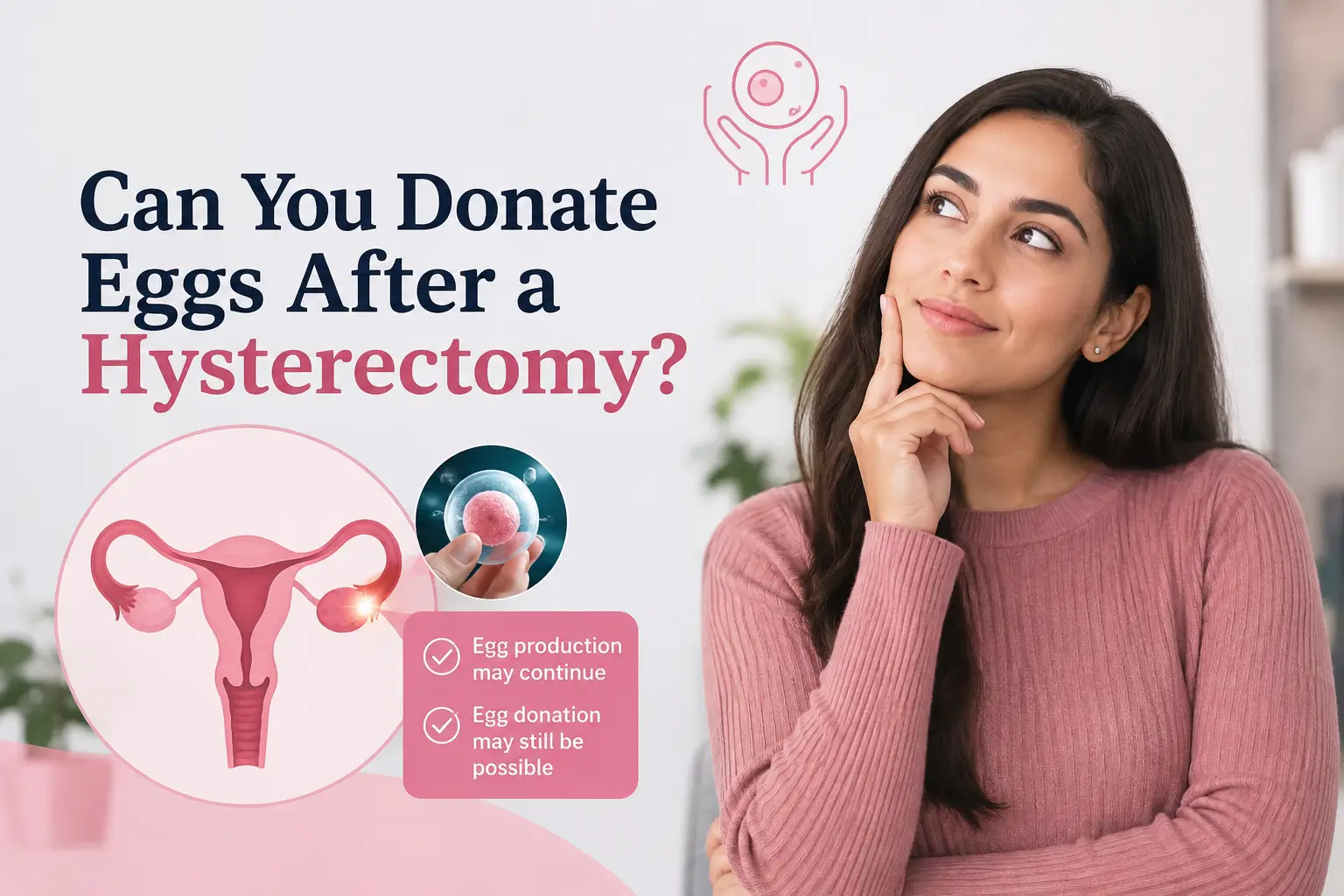
- Yes, you may be able to retrieve or donate eggs after a hysterectomy if your ovaries were left intact and are healthy.
- A hysterectomy removes the uterus, but it does not always remove the ovaries.
- If both ovaries were removed, eggs cannot usually be retrieved because the ovaries are where eggs are stored.
- Doctors may use hormone tests and ultrasound to check ovarian reserve before approving egg retrieval.
- Age, general health, medical history, ovarian function, and the reason for the hysterectomy can all affect eligibility.
- A fertility specialist should review your surgery records before you consider egg donation or egg freezing.
- You may still be able to donate eggs after a hysterectomy if one or both ovaries remain and are functioning.
A hysterectomy can raise many questions about fertility, especially if you are thinking about egg donation. The important point is that the uterus and ovaries have different jobs. The uterus carries a pregnancy, while the ovaries contain and release eggs.
Because some hysterectomies leave the ovaries in place, egg retrieval may still be possible. However, every situation is different. Your age, ovarian reserve, type of surgery, and overall health must be checked by a fertility specialist. This guide explains what happens to your eggs after surgery, whether donation may be possible, and what to expect during screening.
Can You Donate Eggs After a Hysterectomy?
Yes, in some cases.
A hysterectomy itself does not always stop the ovaries from working. If your ovaries were left in place and still have a healthy ovarian reserve, a fertility clinic may be able to retrieve eggs directly from them.
The key question is not simply whether you had a hysterectomy. It is whether your ovaries were removed during surgery. If both ovaries were removed, there are no remaining ovarian eggs to retrieve.
A medical evaluation is still required before you can be approved as a donor.
Where Do the Eggs Go After a Hysterectomy?
Many people search for where do the eggs go after a hysterectomy because the normal menstrual cycle changes after the uterus is removed.
If your ovaries remain, they may continue developing and releasing eggs. However, without a uterus, you will no longer have normal menstrual bleeding.
The released egg does not need to travel into the uterus. It is eventually broken down and absorbed naturally by the body.
The ovaries may also continue making hormones until natural menopause. However, ovarian function can vary from one person to another after surgery.
Can I Use My Eggs After a Hysterectomy?
If you are asking, “Can I use my eggs after a hysterectomy, the answer may be yes when your ovaries are still present.
A fertility specialist can check whether your ovaries are producing follicles and whether enough eggs may be available for retrieval.
Common tests can include:
- AMH blood testing
- Hormone testing
- Antral follicle count
- Pelvic or transvaginal ultrasound
- Review of your surgical and medical history
Indian Egg Donors lists ovarian reserve testing and reproductive-health evaluation as part of donor screening.
Can You Freeze Eggs After a Hysterectomy?
People also ask, can you freeze eggs after a hysterectomy?
Potentially, yes. Egg freezing depends mainly on whether functioning ovaries remain.
During the process, fertility medications stimulate the ovaries so several eggs can mature. The eggs are then collected and frozen for possible future use.
However, egg retrieval can be more complex after some pelvic surgeries. Your doctor may need to examine the position of the ovaries and determine whether they can be accessed safely.
How Does Harvesting Eggs After Hysterectomy Work?
Harvesting eggs after hysterectomy generally follows the same basic ovarian-stimulation process used in IVF.
You may receive fertility medication for several days. Doctors monitor follicle growth with blood tests and ultrasound. When the follicles are ready, mature eggs are collected from the ovaries.
The exact retrieval approach depends on your anatomy after surgery. This is why an experienced reproductive endocrinologist should assess your case first.
Having ovaries does not automatically guarantee that retrieval will be possible or successful.
What Is the Egg Retrieval After Hysterectomy Cost?
There is no single egg retrieval after hysterectomy cost that applies to everyone.
Costs may depend on:
- Fertility clinic fees
- Blood tests and ultrasound
- Fertility medications
- Egg retrieval procedure
- Anesthesia
- Egg freezing and storage
- Extra imaging or specialist care
If you are donating rather than freezing eggs for yourself, approved donor programs often cover donation-related screening, medication, and retrieval expenses. Program policies can differ, so always ask what is included before agreeing to treatment.
Can a Hysterectomy Be Reversed?
No. In general, the answer to can a hysterectomy be reversed is no.
A hysterectomy permanently removes all or part of the uterus. It is not the same as tubal ligation, which may sometimes be surgically reversed in selected cases.
Although the uterus cannot normally be restored, having functioning ovaries may still provide reproductive options involving retrieved eggs.
Can I Donate My Eggs at Age 40?
Women asking can I donate my eggs at age 40 should understand that most donor programs have much younger age limits.
Egg quantity and quality naturally decline with age. For example, current eligibility information from Indian Egg Donors generally lists donor age ranges around the early twenties through early thirties. However, exact limits can vary by program.
At age 40, traditional egg donation is therefore unlikely through many donor agencies. A fertility doctor can still evaluate your own reproductive options based on your health and ovarian reserve.
Where Can I Donate My Eggs for Money?
If you are searching for where can I donate my eggs for money or egg donation near me, start with established egg-donor agencies and licensed fertility clinics.
Do not choose a program based only on compensation. Check the medical screening process, donor support, clinic credentials, legal information, privacy policies, and what medical expenses are covered.
Indian Egg Donors provides donor screening and application support for people interested in learning whether they may qualify.
How Can You Find Out Whether You Qualify?
Your first step should be to confirm exactly what was removed during your hysterectomy.
Ask for your surgical report or speak with your gynecologist. Then discuss your case with a fertility professional who can check your ovarian reserve and determine whether egg retrieval is medically appropriate.
For information about becoming an egg donor, you can contact:
- Email: info@indianeggdonors.com
- Phone: (212) 661-7177
Eligibility should always be confirmed through proper medical screening rather than assumed from your surgery history alone.
Frequently Asked Questions –
Q. Can you donate eggs if you had a partial hysterectomy?
A. Possibly. If your ovaries remain and function normally, egg retrieval may still be an option. Medical screening is required.
Q. Can you donate eggs if both ovaries were removed?
A. No. If both ovaries were removed, there are no ovarian eggs available for retrieval.
Q. Do ovaries still work after a hysterectomy?
A. They often continue working if they were not removed, although ovarian function may change over time in some people.
Q. Do you still release eggs after a hysterectomy?
A. You may continue to ovulate if your ovaries remain functional. The body eventually absorbs the egg.
Q. Is egg retrieval safe after a hysterectomy?
A. It may be possible, but safety depends on your anatomy, health, ovarian position, previous surgery, and other medical factors. A fertility specialist must evaluate you before treatment.

Dr. Kulsoom Baloch
Dr. Kulsoom Baloch is a dedicated donor coordinator at Indian Egg Donors, leveraging her extensive background in medicine and public health. She holds an MBBS from Ziauddin University, Pakistan, and an MPH from Hofstra University, New York. With three years of clinical experience at prominent hospitals in Karachi, Pakistan, Dr. Baloch has honed her skills in patient care and medical research.
- Dr. Kulsoom Balochhttps://blog.indianeggdonors.com/author/dr-kulsoom/

- Dr. Kulsoom Balochhttps://blog.indianeggdonors.com/author/dr-kulsoom/
- Dr. Kulsoom Balochhttps://blog.indianeggdonors.com/author/dr-kulsoom/

- Dr. Kulsoom Balochhttps://blog.indianeggdonors.com/author/dr-kulsoom/